You Can See Everything is a truly gripping and complex documentary. It’s subject is the infamous Elizabeth Holmes, who allows documentarian and co-director Nathan Fielder unfettered access to her family life in the weeks leading up to her prison sentence for fraud.
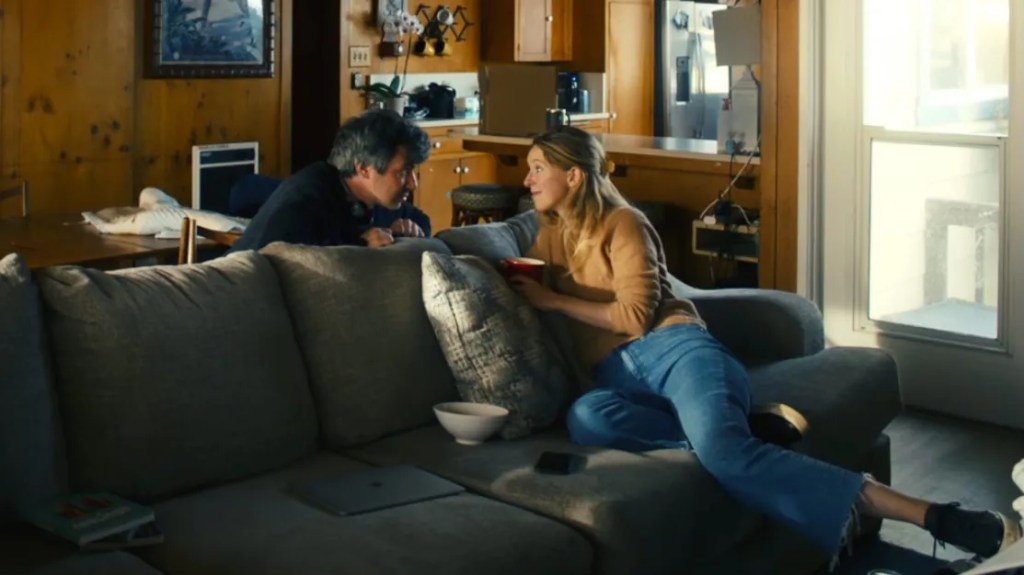
Holmes lives with her husband, Billy Evans, and their children, in a rented house in San Diego which is decked out in sixties wood. Fielder and co-director Lance Oppenheim use the three-hour runtime to allow the audience to “see everything” in the psyches of Holmes and Evans. This is, in part, fly-on-the-wall observations of the couple’s interactions, and in part an extended interview by Fielder over the weeks leading up to the prison sentence.
Naturally, questions are is centred on Theranos, Holmes’s medical tech company that produced a device that essentially claimed could run any blood test, gained huge financial backing, and was then found to have made fraudulent claims which resulted in Holmes’s conviction. Holmes, then, is a more than worthy subject for a film that seeks to delve into the mind of a master manipulator.
And delve it does, as we watch Fielder observe and question Holmes to get to the bottom of the question of whether she truly was and is as much of a compulsive liar as she was found to be in her criminal trial. What ensues are numerous tense sequences in which we play detective and looks for clues in Holmes’ statements and answers. This is assisted greatly by the filmmaking – extreme close ups are the order of the day, as are an undulating and pulsing score underneath the tension. Discussions on semantics of whether the Theranos device “can” do what it claimed to do, and the extent to which Holmes and her buyers could effectively be “talking past each other” are intellectually absorbing. They also suggest that Holmes is either as ignorant as she lets on or just acts that way as part of her sociopathy.
Holmes is also just the start of You Can See Everything’s Intrigue. Billy is just as much of a character – a controlling, all-American family man who suggests some kind of a psychic connection between he and his wife. Then there’s Amanda Seyfried, who played Holmes in a dramatisation and offers her insights on the whole odd situation.
A smart, intriguing and somewhat beguiling work of documentary film that has layers of human strangeness to unpack.
2026, Nathan Fielder and Lance Oppenheim
8.5


