The official poster for Train Dreams [2025] show the film’s protagonist, Robert Grainier, played by Joel Edgerton, standing in half the frame, head bowed and in workwear, with an axe over his shoulder. Trees climb from the top of the frame, surrounded by clouds. It’s a visual suggestion that this is a film about labour and introspection.
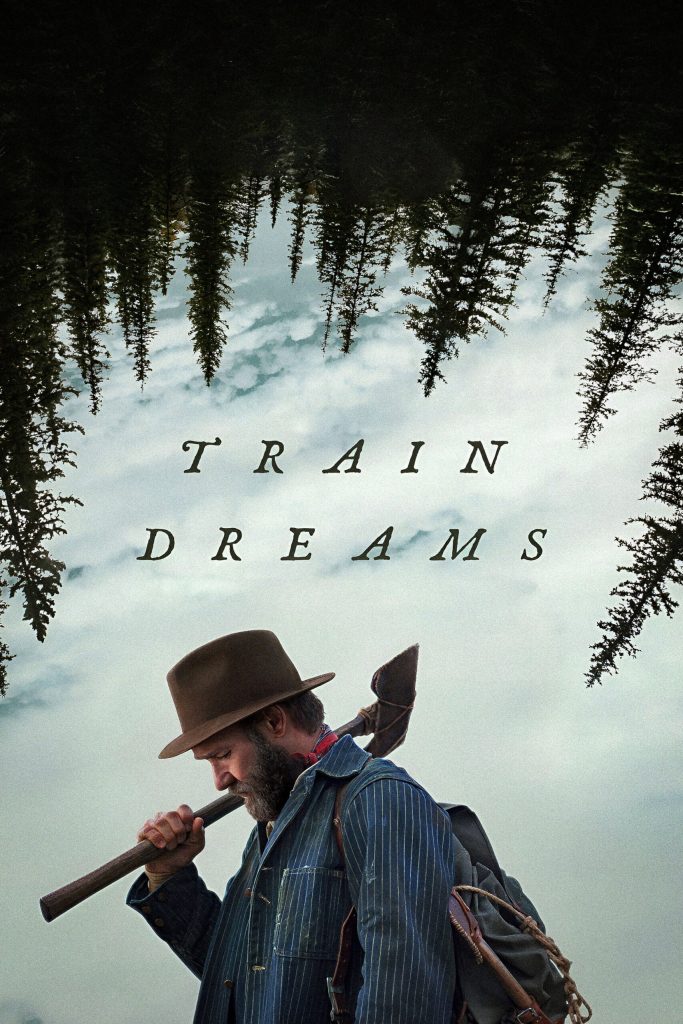
The film is both of those things, but is more readily an exploration of the connection between the two. More specifically, it’s about Grainier’s place in the world; which is America at the turn of the 20th Century, a continually shifting and transforming landscape.
Grainier is a logger who works in the gig economy, cutting down trees with other workmen using rudimentary hand saws. He very much trades his time and physical health for money. However, most significant is the requirement of the job to be away for months at a time, which takes a toll on Grainier’s relationship with his wife and young daughter.
The film unfolds to portray daily life on the job: we vicariously hear about lives lived in the woods; lives dedicated to the grind. In turn of the century America, there was no alternative for these workmen. You stood out in a good way if you had some kind of a special skill (such as in explosives) and in a bad way if you were of a difference race. The US was essentially a developing country in terms of opportunities and equality.
The titular dreams flicker across the screen sporadically in scenes where Grainier sleeps. They serve to show his psyche as he battles his search for meaning and how this conflates with his base desire to be at home more often. Interestingly, this is a theme that is prevalent today, more than 125 years after the film is set. The worker must provide for his family but in doing so does not get to be with his family. This is capitalism and productivity at work and the results thereof. But the film does not lessen itself into petty critique of society – rather, it documents in a stylised way the impact Nor does the film intend to search for answers, because even at the time of writing there is no clear solution. To what extent does a working person balance income with duty to be present in the home? This is ultimately a personal decision and one which can expose one to guilt if the wrong approach is taken (even inadvertently).
Even with the utmost planning around time in a lifespan (which is clearly finite), there are unplanned events and things which can derail even the best laid plans – which is explored in the film.
As a visual and stylistic piece, Train Dreams appears to be very inspired by the work of Terrence Malick with its love for nature as untamed beauty, and humanity as a mere player therein. Woods take the place of sweeping vistas but the sunsets and period-peace outfits are more than reminiscent of, say, Days of Heaven. I also caught wisps of Kelly Reichardt – First Cow most prominently left its mark on the rugged Americana landscapes.
The film covers a lot of life in its runtime and has a general sense of defeat and deflation, although it is not depressing. It is simply realistic in its approach to life and posits realistic responses in the mind of the protagonist. It is comparable to a pastoral painting in earth tones that does not demand attention but records a moment in time.
2025, Clint Bentley

 Reverse Lens